Circle Theorems
Basic theorems plus Kissing circles, Ptolemy's theorem and the Johnson - Tzitzeica theorem

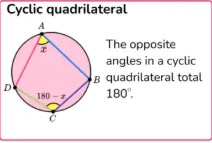
This article highlights some interesting theorems related to circles.
Basic Circle Theorems:
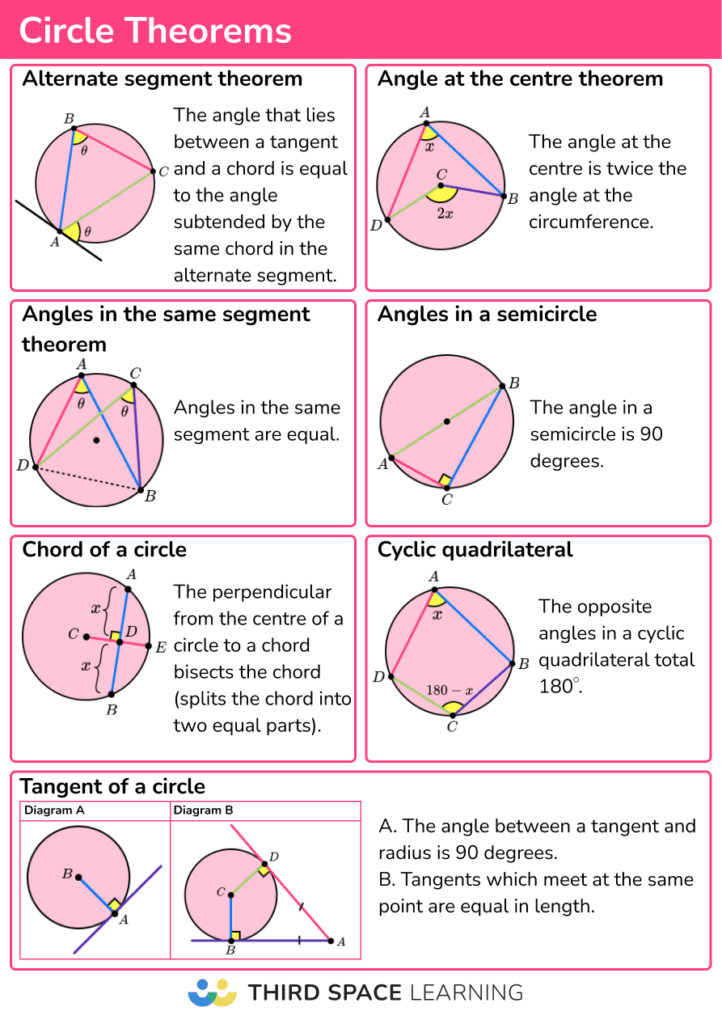
Circle Theorems - GCSE Maths - Steps, Examples & Worksheet
Eight circle theorems (Tim Devereux)
The “circle theorems” shown in the diagram have been well-known for centuries.
Some other results:
Condensed List of All Formulas in Circles - MathBitsNotebook(Geo) - various formulas for circle angles
There are many other interesting items linked to circles such as The Arbelos etc.
Kissing circles:
Descartes' theorem - Wikipedia
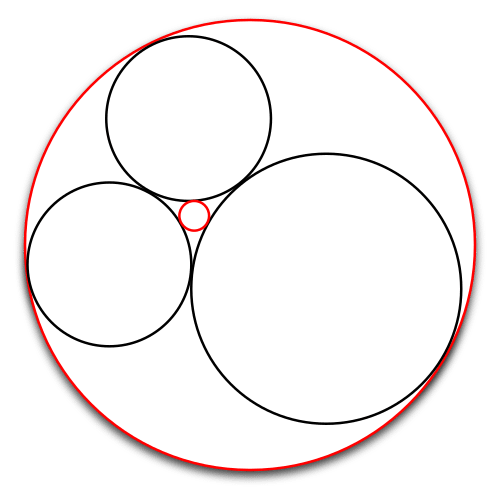
Given three mutually tangent circles (black), there are, in general, two possible answers (red) as to what radius a fourth tangent circle can have.
Two possible answers? Algebraically, that points to some form of quadratic relationship. The problem was solved in 1643 by René Descartes.
The Descartes Circle Theorem - (Theorem of the Day)
Descartes' Theorem and Soddy Circle Radius Calculator | 4 Mutually Tangent Circles
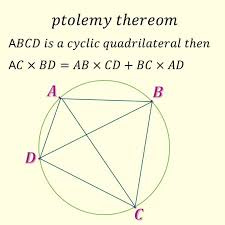
Ptolemy’s theorem:
The Egyptian astronomer, mathematician and geographer Ptolemy (c. 100CE to c.170CE) left us an interesting theorem which is shown in the next diagram.
The Johnson circle theorem:
Roger Johnson (1890 - 1954) and George Tzitzeica (1874 - 1939) both discovered and proved the same theorem around 1916.
Johnson’s Theorem: You Probably Haven’t Heard of This Circle Theorem | by Tony Berard | Intro to Math | Medium
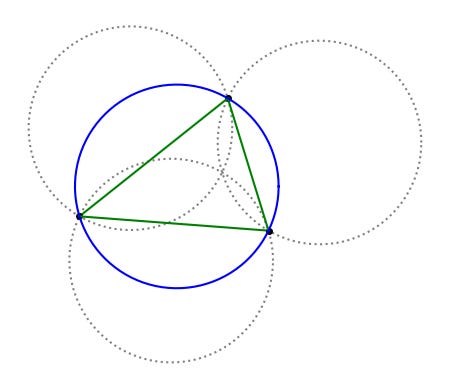
Draw three circles of radius r that intersect at a single point. Then draw a triangle connecting the remaining three points of intersection.
(Each pair of circles intersects in two points, one of which is the point where all three circles intersect, so there are three other intersection points.)
Then the circumcircle of the triangle, the circle through the three vertices, also has radius r.